

Solitaria: Word Puzzle Game
Malpa Games
I went into Solitaria: Word Puzzle Game expecting a familiar word exercise with a card-game wrapper, but its appeal is more specific than that. This is a free word game from Malpa Games that asks you to think about letters while also dealing with the order and arrangement of a solitaire-style puzzle. I found the combination calmer than a timed word challenge and more mentally active than a traditional card game. Its best quality is the way it turns a short vocabulary task into a small sorting problem: I was not only looking for words, but also deciding which move would leave the most useful options for what came next.
That makes it a good fit for people who enjoy quiet, repeatable puzzles rather than dramatic competition. It is aimed at Everyone, works on devices using at least OS 12, and is free to start. The store shows a 4.8 average from around 8.9 thousand ratings, with more than 100 thousand installs, which suggests that the central idea has found an audience. My own view is a little more measured: the design is easy to pick up and pleasantly thoughtful, but players who want a deep word dictionary, a pure solitaire experience, or a completely uninterrupted free game may find the blend less satisfying.
Why the card-and-word combination works
The clever part of the design is that two familiar habits are placed in the same decision. In a normal word puzzle, I usually scan for letters and build the best answer I can see. In a normal solitaire game, I think about exposure, sequence, and whether a move improves the board. Here, those instincts overlap. A word can be attractive on its own, yet using it immediately may not be the best choice if another arrangement would open more useful cards or preserve flexibility.
I liked that extra layer because it gives ordinary vocabulary a practical purpose. Knowing a long or unusual word is not automatically enough; I also have to judge timing. Short words can be valuable when they clear a troublesome section, while a more ambitious word may be better saved until the board offers a stronger route. That is a more interesting rhythm than simply searching for the biggest possible answer every time.
The game also feels approachable because its basic idea is understandable without a long tutorial. If you know how word puzzles work and have seen the broad logic of solitaire, the relationship between the two becomes clear quickly. I could start making decisions almost immediately instead of learning a large collection of special powers, complicated menus, or several unrelated modes. For a casual game, that simplicity is a genuine strength.
Related News






At the same time, the simplicity does not make every round automatic. The board encourages me to look ahead, especially when several possible words compete for the same letters or position. I began checking not only what I could remove now, but what the remaining layout might allow afterward. That small change in attention is the main reason I kept returning: the game rewards patience without demanding a long uninterrupted session.
A useful game for short breaks
My favorite way to use it is in the awkward spaces of the day when I want something more engaging than scrolling but do not have enough time for a full game. A few rounds can fit between errands, during a coffee break, or while waiting for an appointment. The word-and-card format suits those moments because it gives me a clear task without requiring the emotional commitment of a competitive match or a story-driven game.
It also works well when I want a slower mental warm-up. I can begin by spotting obvious words, then become more deliberate as the arrangement gets tighter. That progression makes it suitable for players who enjoy casual brain training, although I would not treat it as a formal learning tool. It may encourage pattern recognition, spelling awareness, and planning, but its main purpose is entertainment.
Gallery
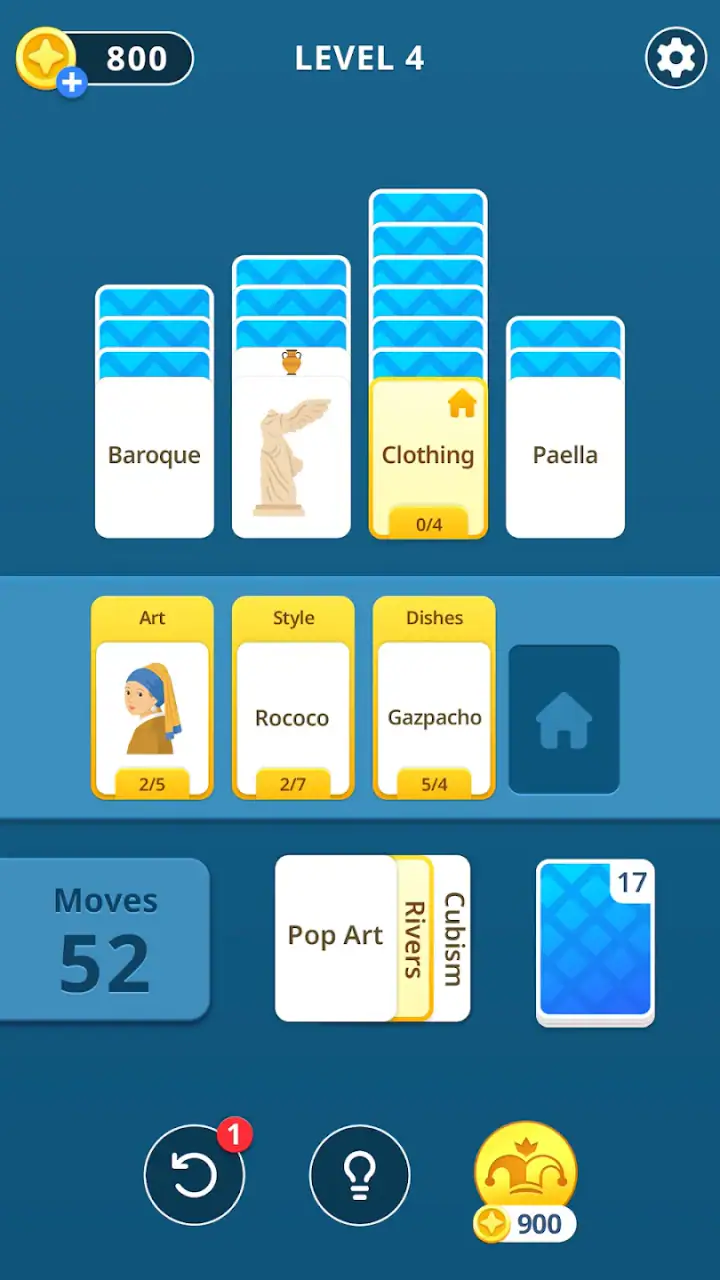
One practical tip is to avoid treating every visible word as equally useful. When I played that way, I sometimes cleared a convenient option and left myself with a worse arrangement. A better routine is to pause for a moment, identify the move that exposes the most possibilities, and only then commit. This is especially helpful when the board presents several short answers that look immediately tempting.
Another useful habit is to think in terms of board health rather than word size. A long answer can feel satisfying, but a smaller move may be strategically stronger if it improves access to the cards behind it. I found this particularly important when I was close to finishing a puzzle and became too focused on quick progress. The game is at its most enjoyable when I accept that a modest move can be the setup for a better one.
Where the experience feels strongest
The strongest evidence in its favor is the balance between recognition and planning. I do not need an expert vocabulary to understand what is happening, yet I cannot rely entirely on the first answer I notice. That middle ground gives the game a gentle learning curve. Beginners can play by instinct, while experienced word-game players can start examining order, leftover letters, and the consequences of each choice.
I also appreciate that the concept does not depend on a large fictional world or a complicated progression system to make a round meaningful. The puzzle itself carries the experience. For someone who prefers clean, self-contained challenges, that is refreshing. The focus stays on finding a route through the current arrangement instead of managing a collection, following a plot, or keeping up with other players.
The developer, Malpa Games, has chosen a recognizable foundation but added enough tension to keep it from feeling like a plain card layout. The result is not a replacement for every solitaire or word app; it is a hybrid for people who want the two activities to influence each other. That distinction matters. If I open it expecting classic solitaire rules with only a decorative word theme, I may be disappointed. If I approach it as a word puzzle where card-like sorting shapes the decisions, the design makes much more sense.
For players who often abandon word games because they feel repetitive, the arrangement element can provide a reason to reconsider a move. The same basic vocabulary skill is used in a different context, and the surrounding layout changes the value of an answer. Conversely, someone who dislikes wordplay may find that the card structure does not remove the need to think about letters. The two halves are connected rather than interchangeable.
The friction I noticed during play
The main weakness is also the unavoidable risk of the concept: the hybrid may feel less pure than either genre on its own. Traditional solitaire players may want the familiar clarity of moving cards according to established rules, without stopping to search for words. Dedicated word-game fans may prefer a larger vocabulary challenge, more direct scoring, or a faster flow. Solitaria sits between those expectations, and that middle position will not suit everyone.
I also found that the experience can become cautious once I understand how important future options are. Instead of making a quick, satisfying move, I sometimes spent longer examining the layout for the safest route. That is good for thoughtful play, but it can reduce the sense of momentum. Anyone looking for rapid-fire rounds or constant urgency should probably choose a timed word game instead.
The free entry point is welcome, but in-app purchases range from $1.99 to $99.99 per item. That does not automatically make the game poor value, yet it is something I would keep in mind before becoming invested in any optional progression or convenience. My advice is simple: start without spending, decide whether the core loop genuinely holds your attention, and only consider a purchase if it solves a problem you actually have. The game is at its best when the puzzle itself is doing the work, not when spending becomes part of the routine.
There is also a difference between being suitable for Everyone and being equally enjoyable for every age or skill level. Younger players who like word discovery may find it approachable, while adults who enjoy relaxing puzzles may appreciate the absence of a harsh competitive tone. But players who need explicit educational feedback, advanced vocabulary explanations, or a structured lesson should look elsewhere. This is a game first, not a spelling course.
Device compatibility is straightforward for newer phones and tablets, since the minimum requirement is OS 12. That makes it accessible to many current users, but anyone holding on to an older device should check compatibility before planning around it. I would also recommend trying a few sessions before judging the game from its first puzzle. The strategic value of the card arrangement becomes clearer after I stop treating each word as an isolated answer.
Who should make room for it
I would recommend it most strongly to people who like both word searches and solitaire-style organization but want something quieter than a competitive puzzle app. It is especially suitable for a player who enjoys asking, “What does this move enable?” rather than simply chasing the largest word. That audience will notice the design’s best quality: every answer can affect the shape of the next decision.
It is also a good choice for casual players who prefer games that can be learned quickly and revisited without a large time commitment. The free price makes it easy to test, and the Everyone rating broadens its appeal for shared household devices. I could imagine introducing it to a relative who already plays card games, then showing how the word layer changes the usual approach without requiring them to learn an entirely unfamiliar genre.
I would be more cautious about recommending it to serious word-game specialists. If your priority is expanding vocabulary, competing on speed, or comparing scores with a large community, a dedicated word app will probably offer a sharper experience. Likewise, if you want the exact logic and comfort of classic solitaire, this game’s letter decisions may feel like an interruption rather than an improvement.
One of the better ways to decide is to identify what kind of concentration you want. Choose this game when you want a gentle puzzle that rewards looking one move ahead. Choose a conventional solitaire game when you want familiar card mechanics with minimal language work. Choose a crossword or anagram-focused title when the words themselves matter more than the arrangement. That distinction saved me from expecting the wrong kind of entertainment from it.
Version, value, and everyday expectations
The current version is 0.3.3, and I would approach it as a focused game that is still best judged by the quality of its central loop rather than by the size of its surrounding ecosystem. The important question is whether the act of sorting and forming words remains enjoyable after the novelty of the combination fades. For me, it does, provided I play in short sessions and do not demand the variety of a much larger puzzle platform.
Its rating and install figures show that the idea has attracted considerable interest, but numbers alone would not convince me to keep a game. What kept me engaged was the practical difference between an obvious move and a useful move. That is a small distinction, yet it gives the rounds enough texture to support repeat play. I could improve by changing my approach, not merely by waiting for a more favorable board.
If you decide to try it, I suggest beginning with a no-pressure session. Do not chase the longest answer, do not spend immediately, and pay attention to how often the arrangement changes the value of a word. After a few rounds, ask yourself whether you enjoy planning around the board or whether you would rather focus exclusively on cards or vocabulary. That test gives a clearer answer than the store summary alone.
There is also a useful trade-off in its accessibility. Because the rules are easy to grasp, the game is inviting for newcomers, but the same simplicity may leave advanced players wanting more specialized challenges. I see that as a boundary rather than a flaw. It knows what kind of relaxation it offers, and it becomes less satisfying only when I ask it to be a full-featured replacement for several different puzzle genres.
My final recommendation
Solitaria: Word Puzzle Game is a thoughtful hybrid with a clear identity. I enjoyed the way it made familiar word choices depend on arrangement and timing, and I found it especially effective as a calm game for short breaks. Its strongest audience is anyone who likes solitaire’s visual sorting but wants more mental involvement than moving cards alone provides.
The limitations are real: the middle ground may frustrate purists, the pace can become deliberate, and the purchase range means I would keep an eye on optional spending. Still, those issues do not erase the quality of the basic idea. I would recommend trying the free version if you want a relaxed word puzzle with a card-game backbone, particularly if you enjoy planning several moves ahead.
My verdict is positive but specific: this is best treated as a quiet strategy puzzle, not as a replacement for classic solitaire or a competitive word arena. In that role, it offers an approachable loop with enough decision-making to stay interesting. If that description matches the kind of game you reach for when you have a few spare minutes, Malpa Games has made a worthwhile choice for your library.
FAQs for Solitaria: Word Puzzle Game
What is Solitaria: Word Puzzle Game?
Solitaria: Word Puzzle Game is a relaxing word-based puzzle experience designed for players who enjoy solving challenges at their own pace. It combines vocabulary, logic, and pattern recognition in a solitary format, making it suitable for short sessions or longer play periods. The game generally focuses on completing word puzzles, discovering solutions, and progressing through increasingly demanding levels.
How do you play Solitaria: Word Puzzle Game?
Gameplay centers on examining the letters, clues, or available puzzle elements presented on the screen and arranging or selecting them to form the correct answer. Each level requires attention to spelling and word relationships rather than fast reflexes. As you advance, puzzles may become more complex, so taking time to test different combinations is often more useful than rushing through a stage.
Is Solitaria: Word Puzzle Game free to download and play?
Solitaria: Word Puzzle Game can typically be downloaded without an upfront purchase, although the exact monetization model may depend on the Android or iOS version available in your region. Some editions may include advertisements, optional in-app purchases, extra hints, or premium content. Before downloading, it is worth checking the store listing for current pricing, ads, and purchase information.
Can I play Solitaria: Word Puzzle Game offline?
Many puzzle games in this category allow at least part of the experience to be played without a constant internet connection, which is convenient during travel or when mobile data is limited. However, features such as advertisements, cloud synchronization, updates, leaderboards, or purchases may require internet access. Availability can vary by version, so testing the game in airplane mode is the safest way to confirm offline support.
Is Solitaria: Word Puzzle Game suitable for all ages?
Solitaria: Word Puzzle Game is generally appropriate for people who enjoy vocabulary challenges and calm, thoughtful gameplay. It may be suitable for older children, teenagers, and adults, but the recommended age can vary according to the store rating and the difficulty of its word content. Parents should also review advertising, in-app purchases, privacy permissions, and language requirements before allowing younger players to download it.
Pros
- Relaxing solitaire gameplay combined with satisfying word puzzles.
- Short levels make it easy to play during quick breaks.
- Gradual difficulty keeps the challenge accessible for most players.
- Clean visuals and simple controls are comfortable on mobile screens.
- Offline play is useful when you have no internet connection.
Cons
- Some puzzles may feel repetitive after extended play sessions.
- Hints or extra moves may be limited without spending in-game resources.
- Difficulty can vary noticeably between consecutive levels.
- Frequent ads may interrupt the flow for free players.
- Players seeking competitive multiplayer may find the experience limited.


